
Read the transcript
Tree root investigation in Melbourne:
how a vac truck exposes roots without harming the tree.
A tree root investigation is a careful dig beside a protected tree to find out where its roots really are.
Arborists and councils also call it tree root mapping.
On a Melbourne building site it usually comes up when a new footing, driveway, retaining wall or service trench would cut into the ground a tree depends on.
The City of Casey's arboricultural report guidelines say all root investigations must be done by non-destructive means, naming supervised hydro excavation as one of them.
That is exactly what a vac truck does.
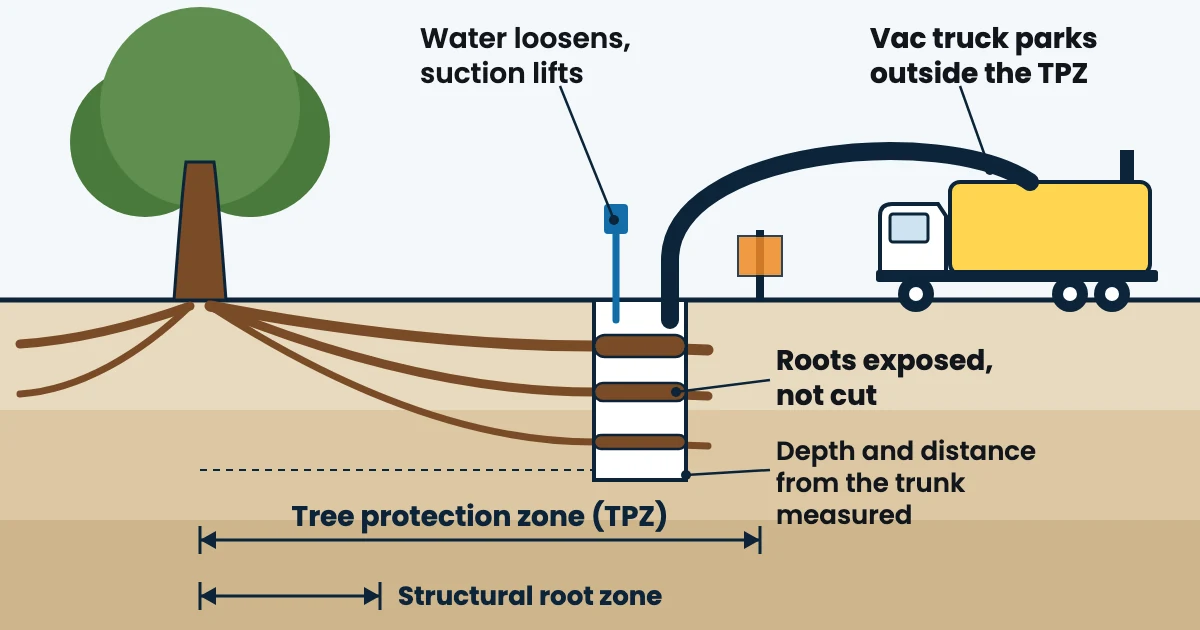
Pressurised water loosens the soil around the roots and suction lifts it straight into the truck's tank, so the roots are left in place for the arborist to measure.
Rapid Vac Trucks Melbourne sends the truck with an experienced operator who works to your arborist's line.
Key takeaways.
A root investigation shows the arborist and the council what roots a design would actually affect.
Councils such as Casey require a non-destructive root investigation, naming supervised hydro excavation as one method.
The project arborist sets the line and records the roots.
Our crew exposes them with water and suction and never cuts them.
Street trees share the nature strip with water, gas, power and telecoms, so plans and locating still come first.
When do Melbourne councils ask for a root investigation?
A root investigation is usually asked for when a design encroaches into a tree's root zone and the impact has to be proven.
Melbourne councils such as Casey and Greater Dandenong point to Australian Standard A S forty-nine seventy, Protection of trees on development sites.
The current edition, from twenty twenty-five, replaced the two thousand and nine edition in May twenty twenty-five.
Casey's guidelines are based on it and set out two clear triggers.
Where a design encroaches more than ten per cent into the notional root zone of a high or medium retention tree, the arborist must show the impact on the tree.
The investigation may include non-destructive excavation such as hydro excavation, or the arborist explains why the encroachment will not cause significant harm.
Where it encroaches more than twenty per cent into the notional root zone, or any work goes inside the structural root zone, a root investigation and mapping report is required, usually as part of the arboricultural impact assessment.
And for a root investigation beside a street tree, contact Council's City Greening team, which may arrange a site meeting to oversee the works.
Other councils take encroachment seriously too.
The reporting guidelines published by Council Arboriculture Victoria, hosted by the City of Whitehorse, say a report that does not properly address protection zone encroachments can be returned to the applicant.
In Casey, works inside the root zone of a listed significant tree also need a planning permit.
Your arborist will know your council's own rules, and the root investigation gives them the facts to work with.
The zones your arborist talks about.
The tree protection zone, or T P Z, is the area of roots and canopy kept clear so the tree survives the build.
The City of Greater Dandenong's tree protection guide explains the usual calculation:
the trunk diameter measured at one point four metres above ground, multiplied by twelve, gives the radius of the zone.
The T P Z is the protected area around the tree.
For Council trees, Dandenong's guide says no persons, vehicles or machinery enter it without the arborist's permission, and soil levels must not change inside it without Council's permission.
The structural root zone is the smaller zone close to the trunk that holds the roots keeping the tree upright.
Casey treats any work inside it as major encroachment.
And the notional root zone is the term Casey uses for the zone that encroachment percentages are measured against.
Roots rarely grow in a neat circle.
Footings, old trenches, kerbs and soil type all push them one way or another.
That is why councils want them found and measured rather than assumed, and why the dig has to leave them intact.
Who does what on the day.
A root investigation is a team job:
the arborist decides, the crew digs, and the council sets the rules.
The project arborist marks the trench line, usually along the edge of the proposed footing or service, and stays to watch and record.
Our operator exposes the roots along that line with water and suction, at the depth the arborist asks for.
We never cut, prune or assess roots; that is the arborist's call, and Dandenong's guide, for example, says no Council tree root over fifty millimetres in diameter is to be severed without Council permission.
How a vac truck exposes roots.
Water does the digging and suction does the carrying, so nothing with an edge comes near the roots.
The soil is washed away from around each root rather than cut, and it goes straight up the hose into the tank, which keeps the trench open and easy to read.
A root investigation with a vac truck runs like this.
One.
Mark the line.
The arborist sets out where the trench goes, how long and how deep, from the design and the T P Z.
Two.
Check the services.
Plans and a locate come first, because street trees and front gardens often share the ground with pipes and cables.
Three.
Expose the roots.
Our operator works along the line with the water lance and suction hose, slowly opening the trench so each root stays whole, with the pressure kept gentle around the roots and the arborist watching.
The truck stands outside the protection zone and the hose reaches in.
Four.
Measure and photograph.
With the roots in view, the arborist records their size, number and depth and takes photos with a point of reference.
Five.
Backfill as directed.
The trench is closed the way the arborist specifies.
The soil leaves in the tank as slurry rather than going back in the hole, so agree the backfill material with your arborist before the day.
The truck usually stays on the road or driveway.
The hose runs across the nature strip or garden to the trench, so heavy wheels do not compact the ground the arborist is trying to protect.
Tell us how far the trench is from where the truck can park, and the hose length is planned around it.
Need roots found before your design is approved?
Call the Melbourne team to book a vac truck and operator for a root investigation, or send your arborist's marked plan for a quote.
Services under the nature strip.
A street tree's roots often run through the same ground as water mains, gas services, power cables and telecoms.
So a root investigation is still an excavation, and the usual checks apply before the first hole.
The guide to working near underground services from WorkSafe Victoria and Energy Safe Victoria sets out the steps.
Get the plans.
Lodge a free enquiry with Before You Dig Australia.
The guidebook says these plans only indicate where services should be, so they should not be the only check before work starts.
Locate on the ground.
Services must be positively located before excavation.
Where positive identification is needed, the guidebook names non-destructive digging and potholing as the methods to use.
Our service locator and ground penetrating radar work can be booked first.
Keep the clearances.
The guidebook's No Go Zone is 300 mm around a service for people and five hundred millimetres for plant or equipment, rising to 3 m for pipelines registered under the Pipelines Act and cables over sixty-six kilovolts.
Some service owners need a wider clearance, and say so in their Before You Dig response.
Follow the owner's conditions.
Permission must be sought from service owners before excavation, and electrical and gas services will require written permission.
Where hydro excavation is used, the service owner sets the maximum water pressure.
Depths vary, so do not assume.
The guidebook says the minimum depth of underground electricity cables can vary from four hundred and fifty millimetres to one thousand millimetres, and actual depths can differ, so follow the service owner's advice on your Before You Dig response.
It also notes that water pipelines may not always show on plans.
In metropolitan Melbourne, the water corporation is Greater Western Water, South East Water or Yarra Valley Water, depending on the suburb, and it can confirm what it owns near your tree.
What gets recorded.
The record is the reason for the dig, and it is what councils call root mapping.
Casey lists what a root investigation and mapping report must include, and the trench needs to be dug so the arborist can capture it:
a site plan showing every excavation line and its length; for each line, its total distance, average depth and closest distance to the centre of the trunk; the size, number and depth of the roots found; photos of each trench and the roots, with a clear point of reference; and the arborist's discussion of what the root loss would mean for the tree.
Our part is a clean, open trench at the depth and position asked for, with the spoil gone, so every root can be seen, measured and photographed in one visit.
Where the soil goes.
The soil and water go up the hose into the truck's tank as the trench is dug, so nothing is stockpiled inside the protection zone.
How that material is disposed of is confirmed for each job, so tell us if the ground has fill or anything unusual in it.
What to send when you book.
Have these ready when you call or send the quote form.
The address and the tree:
where it stands, and whether it is a street tree or on private land.
The arborist's marked plan:
trench lines, lengths, target depth and who will attend on the day.
Any council conditions, for example a City Greening site meeting for a street tree, or permit conditions.
Current Before You Dig plans and any locator or ground penetrating radar mark-out, or ask us to locate first.
Access:
where the truck can park, the distance to the trench, gates, overhead branches and any paving to lift.
Your safe work method statement and induction details.
And for any deeper trenching, you must notify WorkSafe at least three days before construction excavation with a trench deeper than one point five metres, unless it is part of building work with a building permit in force.
Call zero three, eight zero zero seven, two zero zero eight to talk it through, or upload the arborist's plan and photos with the quote form.
The Melbourne team offers a twenty-four seven service, including on-site attendance for urgent and after-hours jobs.
Timing depends on the job, its location and the schedule, and is confirmed when the work is scoped.
Book a root investigation in Melbourne.
Send the arborist's plan and your site details, and we will plan the vac truck and operator around the tree.
This guide is general information, not arboricultural, safety or legal advice.
Council rules, the Australian Standard and service owner conditions change, so check your council's current requirements, your arborist's brief and your Before You Dig Australia plans before work starts.
A tree root investigation is a careful dig beside a protected tree to find out where its roots really are. Arborists and councils also call it tree root mapping. On a Melbourne building site it usually comes up when a new footing, driveway, retaining wall or service trench would cut into the ground a tree depends on. The City of Casey's arboricultural report guidelines say all root investigations must be done by non-destructive means, naming supervised hydro excavation as one of them.
That is exactly what a vac truck does. Pressurised water loosens the soil around the roots and suction lifts it straight into the truck's tank, so the roots are left in place for the arborist to measure. Rapid Vac Trucks Melbourne sends the truck with an experienced operator who works to your arborist's line.
Key takeaways
- A root investigation shows the arborist and the council what roots a design would actually affect.
- Councils such as Casey require a non-destructive root investigation, naming supervised hydro excavation as one method.
- The project arborist sets the line and records the roots. Our crew exposes them with water and suction and never cuts them.
- Street trees share the nature strip with water, gas, power and telecoms, so plans and locating still come first.
When do Melbourne councils ask for a root investigation?
A root investigation is usually asked for when a design encroaches into a tree's root zone and the impact has to be proven. Melbourne councils such as Casey and Greater Dandenong point to Australian Standard AS 4970 Protection of trees on development sites. The current edition, AS 4970:2025, replaced the 2009 edition in May 2025. Casey's guidelines are based on it and set out two clear triggers:
| Situation | What Casey's guidelines expect |
|---|---|
| More than 10% into the notional root zone (NRZ) of a high or medium retention tree | The arborist must show the impact on the tree. The investigation may include non-destructive excavation such as hydro excavation, or the arborist explains why the encroachment will not cause significant harm |
| More than 20% into the NRZ, or any work inside the structural root zone (SRZ) | A Root Investigation/Mapping report is required, usually as part of the Arboricultural Impact Assessment |
| Root investigation beside a street tree | Contact Council's City Greening team, which may arrange a site meeting to oversee the works |
Other councils take encroachment seriously too. The reporting guidelines published by Council Arboriculture Victoria, hosted by the City of Whitehorse, say a report that does not properly address protection zone encroachments can be returned to the applicant. In Casey, works inside the root zone of a listed significant tree also need a planning permit. Your arborist will know your council's own rules, and the root investigation gives them the facts to work with.

The zones your arborist talks about
The tree protection zone (TPZ) is the area of roots and canopy kept clear so the tree survives the build. The City of Greater Dandenong's tree protection guide explains the usual calculation: the trunk diameter measured at 1.4 metres above ground, multiplied by 12, gives the radius of the zone.
- TPZ: the protected area around the tree. For Council trees, Dandenong's guide says no persons, vehicles or machinery enter it without the arborist's permission, and soil levels must not change inside it without Council's permission.
- SRZ: the smaller zone close to the trunk that holds the roots keeping the tree upright. Casey treats any work inside it as major encroachment.
- NRZ: the term Casey uses for the notional root zone that encroachment percentages are measured against.
Roots rarely grow in a neat circle. Footings, old trenches, kerbs and soil type all push them one way or another. That is why councils want them found and measured rather than assumed, and why the dig has to leave them intact.
Who does what on the day
A root investigation is a team job: the arborist decides, the crew digs, and the council sets the rules.
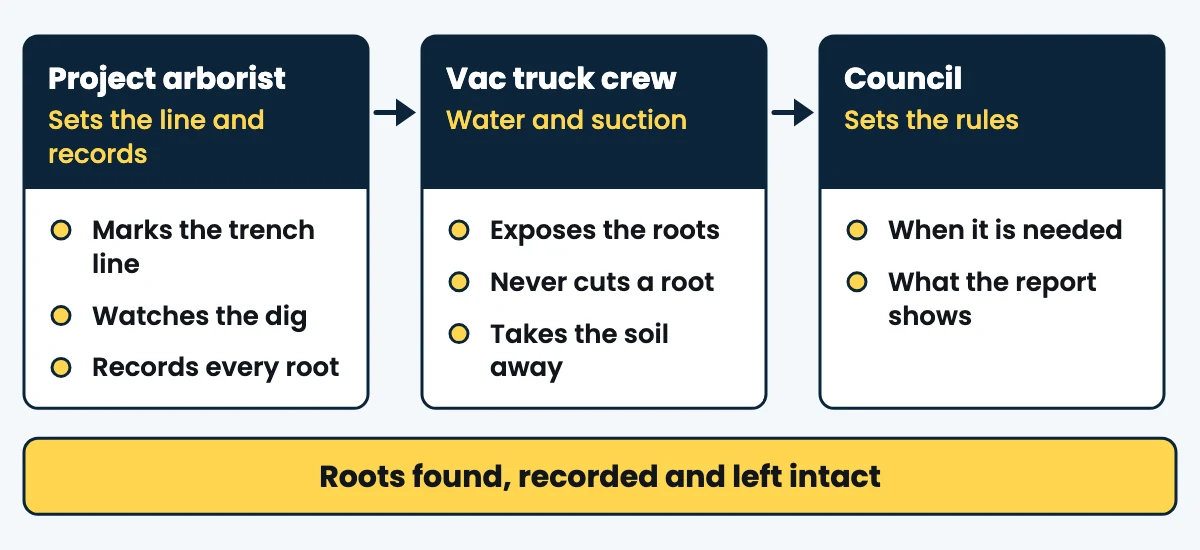
The project arborist marks the trench line, usually along the edge of the proposed footing or service, and stays to watch and record. Our operator exposes the roots along that line with water and suction, at the depth the arborist asks for. We never cut, prune or assess roots; that is the arborist's call, and Dandenong's guide, for example, says no Council tree root over 50 mm in diameter is to be severed without Council permission.
How a vac truck exposes roots
Water does the digging and suction does the carrying, so nothing with an edge comes near the roots. The soil is washed away from around each root rather than cut, and it goes straight up the hose into the tank, which keeps the trench open and easy to read. A root investigation with a vac truck runs like this.
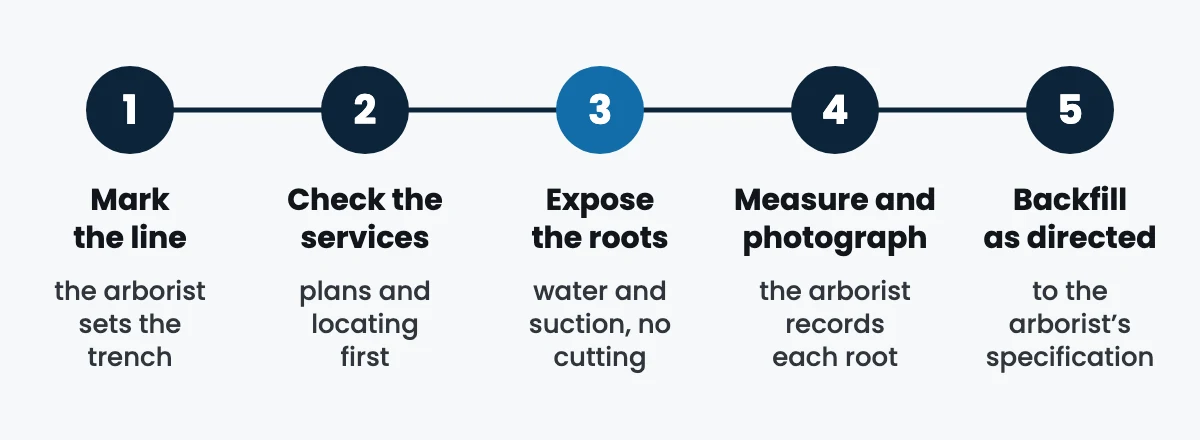
- Mark the line. The arborist sets out where the trench goes, how long and how deep, from the design and the TPZ.
- Check the services. Plans and a locate come first, because street trees and front gardens often share the ground with pipes and cables (see below).
- Expose the roots. Our operator works along the line with the water lance and suction hose, slowly opening the trench so each root stays whole, with the pressure kept gentle around the roots and the arborist watching. The truck stands outside the protection zone and the hose reaches in.
- Measure and photograph. With the roots in view, the arborist records their size, number and depth and takes photos with a point of reference.
- Backfill as directed. The trench is closed the way the arborist specifies. The soil leaves in the tank as slurry rather than going back in the hole, so agree the backfill material with your arborist before the day.
The truck usually stays on the road or driveway. The hose runs across the nature strip or garden to the trench, so heavy wheels do not compact the ground the arborist is trying to protect. Tell us how far the trench is from where the truck can park, and the hose length is planned around it. Read more on our non-destructive digging and vacuum excavation pages.
Need roots found before your design is approved?
Call the Melbourne team to book a vac truck and operator for a root investigation, or send your arborist's marked plan for a quote.

Services under the nature strip
A street tree's roots often run through the same ground as water mains, gas services, power cables and telecoms. So a root investigation is still an excavation, and the usual checks apply before the first hole. The guide to working near underground services from WorkSafe Victoria and Energy Safe Victoria sets out the steps:
- Get the plans. Lodge a free enquiry with Before You Dig Australia. The guidebook says these plans only indicate where services should be, so they should not be the only check before work starts.
- Locate on the ground. Services must be positively located before excavation. Where positive identification is needed, the guidebook names non-destructive digging and potholing as the methods to use. Our service locator and ground penetrating radar work can be booked first.
- Keep the clearances. The guidebook's No Go Zone is 300 mm around a service for people and 500 mm for plant or equipment, rising to 3 m for pipelines registered under the Pipelines Act and cables over 66 kV. Some service owners need a wider clearance, and say so in their Before You Dig response.
- Follow the owner's conditions. Permission must be sought from service owners before excavation, and electrical and gas services will require written permission. Where hydro excavation is used, the service owner sets the maximum water pressure.
Depths vary, so do not assume. The guidebook says the minimum depth of underground electricity cables can vary from 450 mm to 1000 mm, and actual depths can differ, so follow the service owner's advice on your Before You Dig response. It also notes that water pipelines may not always show on plans. In metropolitan Melbourne, the water corporation is Greater Western Water, South East Water or Yarra Valley Water, depending on the suburb, and it can confirm what it owns near your tree.
What gets recorded
The record is the reason for the dig, and it is what councils call root mapping. Casey lists what a Root Investigation/Mapping report must include, and the trench needs to be dug so the arborist can capture it:
- a site plan showing every excavation line and its length;
- for each line, its total distance, average depth and closest distance to the centre of the trunk;
- the size (diameter), number and depth of the roots found;
- photos of each trench and the roots, with a clear point of reference;
- the arborist's discussion of what the root loss would mean for the tree.
Our part is a clean, open trench at the depth and position asked for, with the spoil gone, so every root can be seen, measured and photographed in one visit.

Where the soil goes
The soil and water go up the hose into the truck's tank as the trench is dug, so nothing is stockpiled inside the protection zone. How that material is disposed of is confirmed for each job, so tell us if the ground has fill or anything unusual in it. Our liquid waste removal page covers slurry and pit work.
What to send when you book
Have these ready when you call or send the quote form:
- Address and the tree: where it stands, and whether it is a street tree or on private land.
- The arborist's marked plan: trench lines, lengths, target depth and who will attend on the day.
- Any council conditions: for example a City Greening site meeting for a street tree, or permit conditions.
- Current Before You Dig plans and any locator or GPR mark-out, or ask us to locate first.
- Access: where the truck can park, the distance to the trench, gates, overhead branches and any paving to lift.
- Your SWMS and induction details.
- Any deeper trenching: you must notify WorkSafe at least three days before construction excavation with a trench deeper than 1.5 metres, unless it is part of building work with a building permit in force.
Call (03) 8007 2008 to talk it through, or upload the arborist's plan and photos with the quote form. You can also find us on Google Maps. If it is a small home project, our guide to hiring a vac truck for a residential job covers the basics. The Melbourne team offers a 24/7 service, including on-site attendance for urgent and after-hours jobs. Timing depends on the job, its location and the schedule, and is confirmed when the work is scoped.
Book a root investigation in Melbourne
Send the arborist's plan and your site details, and we will plan the vac truck and operator around the tree.
Frequently asked questions
What is a tree root investigation?
It is a careful excavation along a planned line near a tree, done without cutting the roots, so an arborist can record where the roots are, how big they are and how deep they sit. The findings show whether a footing, driveway or service can go there.
Can a vac truck damage tree roots?
The method is chosen to avoid it. Water loosens the soil and suction removes it, so the roots are exposed rather than cut. Casey's guidelines name supervised hydro excavation as a non-destructive method for root investigations, and the arborist watches the dig.
Who has to be there?
Your project arborist, who marks the line and records the roots, and our operator with the truck. For a street tree, Casey asks you to contact its City Greening team, which may arrange a site meeting to oversee the works.
How is a root investigation priced?
It is quoted from your job details: how long and deep the trench is, where the truck can park and how far the hose runs, and how the spoil is disposed of. Send the arborist's plan and a few photos with the quote form or call (03) 8007 2008.
How deep does the trench go?
As deep as the arborist and the design need, typically the depth of the proposed footing or service. Councils do not set one depth for every job. Tell us the target depth when you book and the truck and hose are planned around it.
Do I still need Before You Dig plans for a root investigation?
Yes. It is still excavation, and street trees often share the ground with services. The WorkSafe Victoria and Energy Safe Victoria guidebook says plans only indicate where services should be, so they are located on the ground before digging.
This guide is general information, not arboricultural, safety or legal advice. Council rules, the Australian Standard and service owner conditions change, so check your council's current requirements, your arborist's brief and your Before You Dig Australia plans before work starts. Sources were checked in November 2026.